Canada is capping permits. The US has added a compliance clock. Australia raised its visa fee. The UK shortened its post-study runway. And in the middle of all of that, Germany quietly set a record.
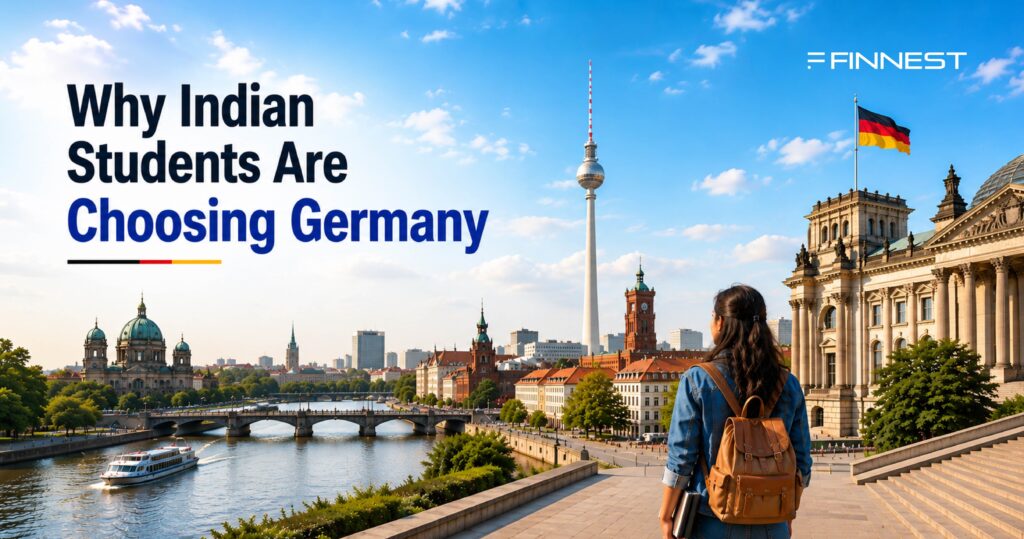
In the 2025/26 winter semester, Germany reached approximately 420,000 international students and doctoral candidates, its highest ever, according to reporting citing German higher education data. That number did not happen by accident. It happened because Germany was moving in the opposite direction from every other major destination at the same time, expanding access, keeping tuition at zero for most programmes at public universities, and building structured pathways from study to employment for graduates who want to stay.
For Indian students in particular, the numbers are striking. India is now Germany’s largest source country for international students, with approximately 59,000 students enrolled, per Economic Times reporting on international enrolment shifts. That is not a niche trend. It is a structural change in where Indian students are directing their ambitions, and it is being driven by specific, calculable reasons.
Why Germany Is Winning the 2026 Comparison
Three factors explain the Germany shift when you lay them out plainly against the alternatives.
| Factor | Germany | UK (Master’s) | Canada |
| Tuition (public university) | Zero or near-zero for most programmes | GBP 15,000 to 30,000 per year | CAD 20,000 to 35,000 per year |
| Post-study work option | Chancenkarte: 12 months job search + part-time work | 18 months Graduate Route (from Jan 2027 apps) | 3-year PGWP |
| Visa policy direction (2026) | Expanding access | Tightening (dependent ban, shorter runway) | Tightening (cap, SDS closed) |
| English-taught STEM options | Large and growing | Available widely | Available widely |
| Graduate employment demand | Active labour shortage in STEM and engineering | Competitive market | Competitive market |
The comparison on tuition is the one that changes the financial conversation most dramatically. When both a UK master’s and a German master’s can be delivered in English, in one to two years, in world-ranked institutions, the tuition differential is not a marginal consideration. It is the central one.
The Zero-Tuition Model: What It Actually Means
Most public universities in Germany charge no tuition fee for degree programmes, for domestic and international students alike. What students do pay is a semester contribution, which varies by institution and state but typically covers administrative costs, student union membership, and in many cases a public transport pass for the local region. This is a fundamentally different cost structure from any other major study abroad destination.
The practical implication: the largest single expense for most Indian students in Germany is not tuition. It is the cost of living, which is why the Sperrkonto, the blocked account proving you can cover monthly living costs, is Germany’s primary financial visa requirement. For the full mechanics of setting that up from India, including provider comparisons and the EUR 12,050 buffer rule, see our dedicated German blocked account guide.
This also means that the Return on Learning calculation for Germany starts from a different baseline than for the US or UK. A student who finances two years in Germany on a combination of minimal tuition and managed living costs is carrying a much smaller loan at graduation than a student who financed two years at a full-fee UK or Australian institution. The break-even timeline is shorter, and the monthly EMI is lower, even if the destination salary on the other side is also lower than what New York or London might offer. Source: Y-Axis Germany master’s guide.
India as Germany’s Largest Source Country
India’s position as Germany’s largest source country for international students is a relatively recent development, and it reflects the specific profile of students who are choosing Germany. The programmes drawing the most Indian applicants are in STEM, engineering, and applied sciences, exactly the fields where Germany’s academic reputation is strongest and where industry connections to employers in automotive, manufacturing, and emerging technology sectors are deepest.
The English-taught master’s landscape in Germany has grown substantially. Programmes in AI, data science, computer science, robotics, mechanical engineering, and renewable energy are now widely available at major institutions in English, removing the language barrier that previously made Germany a harder first-choice for students without prior German proficiency. Source: Y-Axis Germany master’s guide.
That said, students who plan to stay and work in Germany after graduation need to treat German language acquisition as a parallel commitment from the start of their programme. Most professional environments outside international firms and English-medium research roles require functional German, and the students who integrate most successfully in the German job market are the ones who invested in the language during their studies rather than after.
The Chancenkarte: Germany’s Study-to-Work Bridge
Germany’s Opportunity Card, the Chancenkarte, is one of the more practically useful post-study instruments available in any major destination right now. It gives qualified non-EU nationals a 12-month stay permit specifically to search for skilled employment, without needing a job offer in hand to enter that period. Source: German Federal Foreign Office, Chancenkarte explainer.
| Feature | What It Means in Practice |
| Duration | 12 months to search for qualifying skilled employment |
| Work During Search | Part-time work permitted during the job-search period to support living costs |
| Points-Based Route | Eligibility based on qualification, work experience, language skills, and age |
| Transition Path | After finding a qualifying role, transition to a standard German work permit |
| Higher Requirement vs. Student Visa | EUR 13,092 per year in the blocked account (EUR 1,091/month, vs EUR 992 for student visa) |
The combination of zero tuition during study and a structured 12-month job-search pathway after graduation creates a study-to-employment pipeline that is more predictable than most alternatives at equivalent cost. Compare this with the UK Graduate Route, now 18 months for master’s graduates applying from January 2027, or the US OPT window, now compressed by the 30-day grace period reduction, and Germany’s post-study framework looks increasingly competitive.
The Policy Divergence: Why Timing Matters
The Germany surge is not happening in isolation. It is happening precisely because the Big Four are tightening simultaneously. As reported in the Economic Times analysis of international enrolment shifts, Germany and France are seeing record enrolment in 2025/26 at the same moment that US, Canada, and UK numbers are declining. That timing is not coincidental. It is students and families doing the comparison and reaching rational conclusions about where the value is.
For a full account of what has changed in the Big Four destinations, see our Big Four visa crackdowns guide. The point for Germany planning purposes is that the window where Germany has a pronounced advantage may not remain permanent. Other European destinations are watching the same inflows and may introduce their own capacity management measures in coming years. Students who are considering Germany for a 2026 or 2027 intake are entering in a period where the policy environment is actively favourable, not a period where they should assume that environment will remain unchanged indefinitely.
Practical Checklist: Applying to Germany in 2026
• Language test: Most English-taught programmes require IELTS 6.5 or equivalent. Some programmes also request basic German (A1 or A2) even for English-medium degrees to support daily life integration.
• APS certification: Indian applicants to German universities are typically required to obtain APS (Academic Evaluation Centre) certification of their Indian academic credentials. This involves document verification and an interview; allow two to three months for this process.
• Sperrkonto (blocked account): Required before the visa appointment. EUR 11,904 for a student visa, EUR 13,092 for a Chancenkarte. Transfer EUR 12,050 to 12,100 to account for fee deductions. See our Sperrkonto guide for provider comparisons.
• Health insurance: Mandatory for enrolment. Public statutory insurance (GKV) is available to full-time students at reduced rates; private international health insurance is also accepted in some cases.
• Visa appointment: Book early. German consulate appointments for student visas in India, particularly in Chennai, Mumbai, and Delhi, can be booked out several weeks in advance during peak application seasons.
TCS, LRS, and the India-Side Financial Picture
The same LRS and TCS framework applies to Germany as to any other study abroad destination. For a student whose total annual remittance to Germany stays below Rs. 10 lakh, no TCS applies at all. Germany’s lower annual cost structure means this threshold is more achievable per semester than it would be for an equivalent UK or US programme.
For remittances above Rs. 10 lakh, self-funded transfers attract 2 percent TCS from April 2026, while loan-funded remittances attract 0 percent. For families financing Germany through an education loan, the nil-TCS benefit is available regardless of the total amount transferred. For the full mechanics of structuring a German programme’s financing, see our LRS tuition transfer guide.
How Finnest Helps With Germany Planning
Germany’s financial structure is genuinely different from the US, UK, and Canada, and the planning conversation reflects that. The Sperrkonto setup involves a provider comparison, a currency conversion decision, and a timing call against the visa appointment. The APS process has its own timeline that needs to align with the overall application calendar. And the Return on Learning calculation looks different when tuition is near zero and the primary cost driver is living expenses across two or three years.
We help families build that calculation with real numbers: the Sperrkonto options and their true all-in costs, the loan structure that preserves nil-TCS treatment on remittances, and the post-graduation salary data for the specific field and state in Germany the student is targeting. A graduate in Munich in software engineering has a different earning profile than a graduate in Leipzig in renewable energy, and the ROL calculation needs to reflect that.
For how Germany compares against other non-traditional destinations for Indian students in 2026, see our Japan and Spain Plan B guide and our broader best countries for Indian students guide. For the AI-era programme selection question that drives most STEM destination decisions, see our AI era course selection guide. See how we work on our services page.
Talk to a Finnest counsellor: https://finnest.in/contact-us/
Frequently Asked Questions
Is it true that public universities in Germany are free?
Mostly yes. Most public universities in Germany charge no tuition fee for their degree programmes, for international students as well as domestic ones. What students pay is a semester contribution, typically a few hundred euros per semester, which covers administrative fees, student union membership, and in many states a regional public transport pass. Private universities and some specialised business schools do charge tuition, so the zero-tuition rule applies specifically to public institutions.
Do I need to speak German to study there?
Not for the programme itself, if you choose an English-taught programme. The range of English-medium master’s options in Germany has grown substantially, particularly in STEM, engineering, and data science fields. However, for daily life, for part-time work during studies, and for professional integration after graduation outside English-medium employers, German language proficiency matters significantly. Students who plan to work in Germany after graduating should treat German as a parallel curriculum commitment from the start, not an optional extra.
What is the blocked account requirement and how much do I need?
The Sperrkonto is a mandatory proof-of-funds instrument for the German student visa. For a student visa in 2026, the requirement is EUR 11,904 per year, releasing EUR 992 per month after arrival. For a Chancenkarte, it is EUR 13,092 per year. The account is set up before your visa appointment through a provider like Expatrio or Fintiba, funded from India via SWIFT or Flywire, and a blocking confirmation document is submitted with your visa application. Always transfer slightly more than the required amount to cover intermediary fees. Our complete Sperrkonto guide covers all the steps.
How does the Chancenkarte help Indian graduates specifically?
After completing a degree in Germany, Indian graduates can use the Chancenkarte as a structured 12-month bridge to find skilled employment without needing a job offer before the search period begins. During those 12 months, part-time work is permitted to help cover living costs. Once a qualifying role is found, the transition to a standard work permit follows an established process. This is particularly valuable for students whose target employers run longer hiring cycles, since the 12-month window provides enough time to go through multiple rounds and negotiate an offer without the time pressure that a shorter grace period creates.