
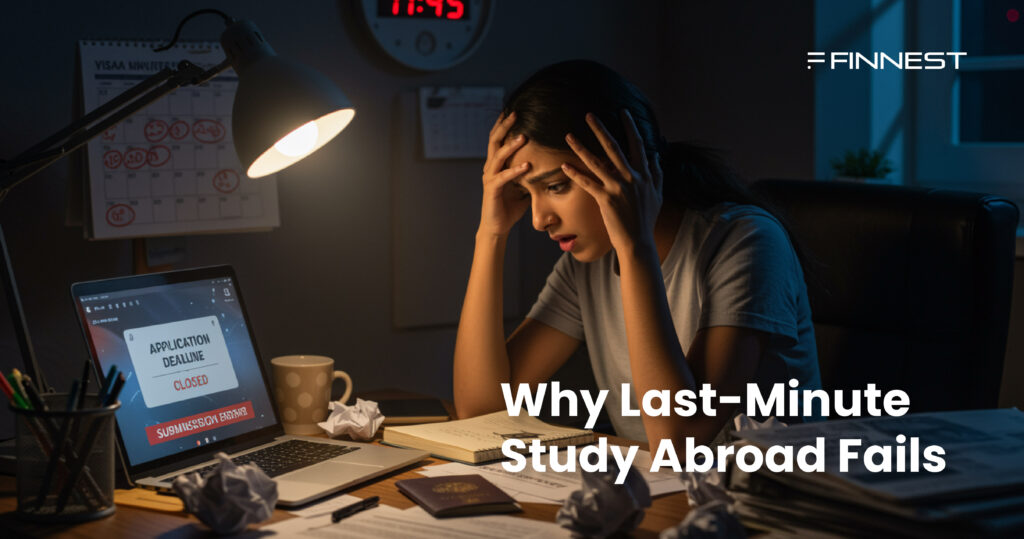
A study abroad journey is not a single decision, it is a sequence of financial, academic, and regulatory commitments. When that sequence is compressed into a few rushed months, the cost multiplies.
Last-minute planning rarely fails because of intelligence or ambition. It fails because international education operates on fixed systems — application cycles, scholarship windows, visa documentation timelines, financial proof requirements, and currency fluctuations. These systems reward structure and penalize urgency.
Students who delay planning often face:
- Missed scholarship deadlines
- Higher test and courier costs
- Expensive flight bookings
- Poor forex timing
- Weak financial documentation for visas
- Limited education loan options
What appears to be a “quick decision” gradually turns into financial leakage.
At Finnest, we view study abroad as a financial architecture problem. When timelines are aligned, exams, funding, loans, forex, visa filings — costs are controlled. When they are rushed, money flows in the wrong direction.
Planning early is not about fear. It is about protecting your capital, your admission, and your long-term stability.
The Psychology of “I’ll Figure It Out Later”
Most last-minute study abroad decisions don’t begin with poor intent.
They begin with postponement.
The assumption is simple: Admission first. Details later.
But international education doesn’t function on assumptions, it functions on structure.
Overconfidence in Admission Chances
Many students believe strong grades alone guarantee success. They delay test preparation, scholarship research, and financial planning, assuming everything else can be arranged once an offer arrives.
What they discover later is that admission is only one part of the equation. Funding proof, visa compliance, and timeline coordination matter just as much.
Underestimating Documentation Complexity
A study abroad application is layered:
- Academic records
- Financial statements
- Income proofs
- Tax documents
- Loan sanction letters
- Currency declarations
Each document must be accurate, consistent, and aligned.
When preparation starts late, errors increase — and corrections become expensive.
The False Belief That Money Can Solve Everything
There is a common belief that urgency can be fixed with spending:
- Pay extra for faster processing
- Book premium appointments
- Convert currency at any rate
- Choose any available lender
But throwing money at poor timing does not create stability. It often creates long-term financial strain.
At Finnest, we see planning not as delay, but as control.
When your financial roadmap is structured early, decisions become strategic, not reactive.
The Financial Trap of Rushed Applications
When timelines shrink, costs expand. What could have been planned calmly becomes an emergency, and emergencies are expensive.
Paying Premium Prices for Emergency Services
Late test bookings, urgent document notarizations, priority visa appointments, express attestations, each comes with an added fee. Individually, they seem manageable. Together, they quietly inflate your total budget.
Planning early avoids paying for speed.
Last-Minute Flight Tickets: The 300% Markup
Airfares rise sharply close to departure dates, especially during peak student seasons.
Booking late often means:
- Limited route options
- Higher baggage costs
- Non-flexible tickets
The same flight can cost significantly more simply because of timing.
Currency Exchange: Losing Money on Urgent Forex Conversions
When tuition deadlines are near, students convert funds at whatever rate is available.
Without monitoring exchange trends or planning staged transfers, even small rate differences can translate into large losses on tuition and living expenses.
Timing in forex is not speculation, it is cost control.
Expedited Courier and Document Processing Fees
Universities and visa offices require physical documentation in many cases.
Late preparation often means:
- International express shipping
- Urgent transcript dispatch
- Faster document legalization services
All at premium pricing.
At Finnest, we structure timelines to prevent financial leakage. Because in study abroad planning, urgency is rarely strategic, and almost always expensive.
How Finnest Helps with Study Abroad Financial Management
Studying abroad is not just an academic decision, it is a financial commitment that spans tuition, living expenses, currency movement, visa compliance, and long-term repayment planning.
At Finnest, we focus on one core objective: financial clarity before financial commitment.
Structured Education Loan Planning
We help you evaluate secured and unsecured loan options, compare interest structures, understand repayment terms, and align sanction timelines with your admission and visa process.
Scholarship & Funding Alignment
Funding deadlines often close before admission confirmations. We guide you on timing, documentation, and positioning so you don’t miss financial opportunities due to poor sequencing.
Visa-Ready Financial Documentation
Clear bank statements, consistent income proof, tax returns, and compliant fund history matter. We help structure your documentation so it tells a credible and coherent financial story.
Forex & Fund Transfer Planning
Currency fluctuations impact your total cost. We assist in planning staged transfers and timing conversions strategically instead of reacting under pressure.
Blocked Account & Proof of Funds Guidance
For countries that require it, we guide you on when and how to initiate blocked accounts and manage proof-of-funds requirements without unnecessary capital exposure.
Finnest does not just help you arrange money. We help you plan it, protect it, and position it correctly.
Plan Early. Spend Smarter.
Connect with Finnest and structure your study abroad finances with confidence.
The Scholarship Graveyard: What You Miss When You Rush
Scholarships reward preparation, not panic. When applications are rushed, funding opportunities are often the first casualty.
Deadlines That Pass You By
Many merit-based and country-funded scholarships close months before final university deadlines.
Students who begin late often realize that the most generous funding windows have already shut. What remains are limited or highly competitive options.
Timing determines eligibility.
Essays That Lack Depth and Authenticity
Strong scholarship essays require reflection, not overnight drafting.
Leadership experiences, career vision, impact stories, and long-term goals must be articulated clearly and credibly. When written under pressure, essays often sound generic or incomplete, reducing selection chances.
Recommendation Letters That Feel Generic and Hollow
Professors and employers need time to craft meaningful letters.
Last-minute requests result in brief, surface-level recommendations that fail to highlight strengths or differentiate you from other applicants.
Quality requires notice.
Portfolio and Profile Gaps You Could Have Filled
Research projects, internships, volunteering, certifications — these profile enhancers take time.
Students who plan early can strengthen their applications intentionally. Those who rush apply with whatever profile they currently have, not the one they could have built.
At Finnest, we emphasize that scholarship success is strategic. Preparation creates positioning, and positioning unlocks funding.
The Visa Rejection Cascade
A visa rejection is rarely caused by one document.
It is usually the result of inconsistencies, weak financial history, or incomplete preparation, especially when the process is rushed.
When timelines shrink, documentation suffers. And visa officers are trained to notice gaps.
Insufficient Fund History: The #1 Red Flag for Officers
Sudden large deposits in bank accounts shortly before visa filing raise immediate concerns.
Embassies look for stable, traceable fund history, not last-minute transfers. Without proper financial seasoning, even sufficient funds can appear questionable.
Bank Statements That Don’t Tell a Clear Story
Your financial documents must align:
- Income source
- Savings pattern
- Loan sanction letters
- Sponsor relationship proof
When statements are inconsistent or poorly structured, they create doubt. A visa application is not just about showing money, it is about showing credibility.
Missing Tax Returns and Income Proof
Sponsors must demonstrate legal and sustainable income.
Missing ITRs, incomplete salary records, or unclear business income statements weaken the financial narrative. These gaps are harder to fix when discovered late.
No Time to Fix a Rejection Before Your Intake Starts
If a visa is rejected close to the course start date, you may not have:
- Time to reapply
- Time to correct documentation
- Time to secure a new appointment slot
This can result in deferral, lost deposits, or an entire academic year delayed.
At Finnest, visa documentation is approached strategically — not reactively.
Because in international education, financial clarity directly impacts visa approval probability.
The Accommodation Crisis
Housing is one of the most underestimated parts of study abroad planning. When applications are delayed, accommodation becomes reactive, and expensive.
Paying 40% More for Last-Minute Housing
On-campus housing fills months in advance.
Students who start late are often left with limited private options at higher prices. Peak intake season drives rents up, and urgency reduces your ability to negotiate or compare.
What could have been planned within budget turns into an inflated monthly commitment.
Falling for Rental Scams and Fake Listings
When time is short, verification is skipped.
Fake listings, advance deposit scams, and misleading contracts become real risks, especially in high-demand student cities. Pressure makes students transfer funds without proper checks.
Financial loss at this stage is not uncommon.
Settling for Unsafe or Unhygienic Living Situations
Limited availability forces compromises:
- Longer commute times
- Poor neighborhood safety
- Shared spaces beyond comfort
- Substandard facilities
Accommodation directly affects academic focus and well-being.
The Stress of Arriving with No Place to Stay
Arriving in a new country without confirmed housing creates immediate logistical and emotional strain.
Temporary stays, expensive short-term bookings, and constant relocation in the first few weeks disrupt what should be a stable transition period.
At Finnest, we emphasize timeline discipline because financial planning is not limited to tuition and loans. Housing is part of the equation — and late decisions often make it the costliest surprise.
Education Loans: The Rush Hour Penalty
Education loans require evaluation, comparison, documentation, and negotiation.
When the timeline is compressed, financial decisions become reactive — and expensive.
Limited Time to Compare Lenders and Interest Rates
Different lenders offer varying interest structures, moratorium terms, processing fees, and repayment flexibility.
Students who apply late often accept the first approval they receive, without comparing long-term cost implications. Even a small interest difference can significantly increase total repayment over time.
Settling for Unsecured Loans with Higher Interest
Secured loans typically offer lower interest rates but require collateral evaluation and documentation.
When deadlines are close, students may opt for faster unsecured loans — often at higher interest and stricter repayment terms. Speed comes at a price.
Missing Out on Subsidized Interest Schemes
Certain schemes offer interest subsidies during the moratorium period or reduced rates under specific eligibility criteria.
These require time to process and verify eligibility. Rushed applications may overlook such opportunities entirely.
Collateral Arrangements Made in Panic
Property valuation, legal verification, and ownership documentation take time.
When arranged in urgency, mistakes can occur, incomplete papers, delayed approvals, or unfavorable terms. Panic-driven decisions can affect long-term family assets.
At Finnest, loan planning begins early and strategically. Because an education loan is not just funding, it is a multi-year financial commitment that deserves structured decision-making.
Hidden Costs of a Hurry-Burry Departure
Not all financial losses are visible in tuition invoices or loan statements. Some costs quietly accumulate when preparation time disappears.
No Time for Scholarship Reinvestigations
Many universities offer internal bursaries, assistantships, or fee waivers even after admission.
Students who rush often accept their first offer without reviewing additional funding avenues. A few weeks of structured research could reduce overall cost significantly.
Missing Part-Time Job Opportunities on Campus
On-campus roles, research assistantships, and student employment positions often open before the semester begins.
Late planners arrive without awareness or preparation — missing opportunities that could offset living expenses from the very first term.
Overpaying for Textbooks and Course Materials
Students who plan early explore:
- Used books
- Digital editions
- Library access
- Student exchange groups
Rushed arrivals often purchase materials at full retail price without comparison, increasing initial settlement expenses.
Health Insurance Purchased at Inflated Rates
Health coverage is mandatory in many countries.
Without time to compare university-approved providers and alternative plans, students may choose higher-cost policies under pressure. Poor selection can also result in limited coverage or unnecessary add-ons.
At Finnest, we view financial planning as a comprehensive process — not just tuition management.
Because the true cost of rushing is often hidden in decisions made under pressure.
The Mental and Academic Toll
Financial stress does not end at visa approval. When preparation is rushed, students often begin their international journey already exhausted, mentally and strategically unprepared.
Starting Your Journey Already Burnt Out
Weeks of urgency, document chasing, loan pressure, housing uncertainty, forex stress, take a toll.
Instead of arriving excited and focused, students arrive fatigued. This impacts early academic performance and confidence during the crucial first semester.
Difficulty Adjusting Due to Lack of Preparation
Cultural transition, academic systems, grading styles, and classroom expectations differ significantly across countries.
Without prior research and mental readiness, adjustment becomes overwhelming. What should be adaptation becomes anxiety.
Poor Course Selection Leading to Transfers or Dropouts
Rushed decisions sometimes lead to:
- Selecting programs without full curriculum review
- Ignoring specialization alignment
- Overlooking long-term career pathways
Course changes, transfers, or dropouts are not just academic setbacks, they are financial losses involving additional tuition, visa complications, and delayed graduation.
The Hidden Cost of Wasted Tuition Fees
Every semester carries fixed costs: tuition, housing, insurance, living expenses.
When academic decisions are poorly structured, the financial impact compounds quickly. A single misaligned term can translate into significant monetary waste.
At Finnest, planning is not just about documentation or funding. It is about ensuring you begin your study abroad journey stable, confident, and strategically aligned, not recovering from a rushed start.
Frequently Asked Questions About Last-Minute Planning
Can I Still Study Abroad If I Just Decided Today?
Yes, but your options may be limited.
You may need to:
- Target universities with rolling admissions
- Accept fewer scholarship opportunities
- Arrange faster (often costlier) financial solutions
It’s possible, but it requires realistic expectations and structured financial control from day one.
What Happens If My Visa Gets Rejected Close to the Intake?
A late rejection can trigger:
- Loss of tuition deposits
- Accommodation cancellation charges
- Flight rebooking costs
- Forced deferral to the next intake
With limited time to reapply, students often lose both money and momentum. Early preparation reduces this risk significantly.
How Much Extra Money Do Last-Minute Students Typically Waste?
While the exact amount varies, rushed applicants often incur higher costs in:
- Flights
- Forex conversions
- Express documentation
- Premium loan options
- Temporary accommodation
The cumulative impact can run into lakhs, not because education is expensive, but because urgency is.
Is It Better to Defer or Go Rushed?
If documentation, funding, and visa timelines are unstable, deferring is often the financially wiser choice.
A structured 6–12 month preparation window can:
- Improve scholarship chances
- Reduce loan burden
- Strengthen visa approval probability
- Lower overall stress
At Finnest, we evaluate readiness objectively. Because sometimes, waiting strategically is not a delay, it is protection of your investment.